GENOA TELEPSYCHIATRY

Reducing Evaluation Time in a Physician Recruitment Workflow

Improving physician evaluation by reducing cognitive load and eliminating manual, repetitive tasks.

Overview

Genoa Telepsychiatry connects physicians with clinics in underserved areas.

A key step in this process is the Intro Call, where physicians are evaluated and shortlisted. This workflow was manual, fragmented, and time-consuming, directly impacting how quickly providers could be matched to a clinic.
ROLE:
UI/UX Designer
SCOPE:
Owned the redesign of the physician evaluation workflow, from research and problem definition through interaction design and UI, collaborating with Product, Engineering, and the Physician Partnerships team.

Users & Context

The primary users were Physician Partners, a small team responsible for evaluating and shortlisting physicians through Intro Calls.

Despite the small team size, their role was critical—they directly impacted how quickly physicians could be qualified and matched with clinics.

To understand their workflow, I:
  • conducted in-depth interviews with the team
  • reviewed onboarding materials and call scripts
  • analysed recorded Intro Calls to observe real usage
This helped identify not just process inefficiencies, but also the cognitive load of managing multiple tools during live conversations.
Given the small, expert user group, depth of understanding was prioritised over scale.

Problem

Physician Partners were spending ~55 minutes per candidate due to:
  • switching between multiple tools during live calls
  • manually capturing across spreadsheets and re-entering data in the CRM
  • navigating a non-linear workflow
  • high cognitive load while interviewing
This resulted in:
  • Slower time to place a physician
  • limited throughput of qualified providers
  • higher operational cost

Goal

Reduce the time required to evaluate and place a physician by:
  • streamlining Intro + Post Call workflows
  • eliminating duplicate work
  • reducing cognitive load during live calls
  • improving consistency and speed of evaluation

Key Insight

The problem wasn’t just inefficiency.
It was cognitive overload during a live conversation.
Physician Partners had to:
  • conduct the interview
  • navigate tools
  • track missing data
  • prepare for evaluation
This fragmented attention and slowed everything down.

Approach

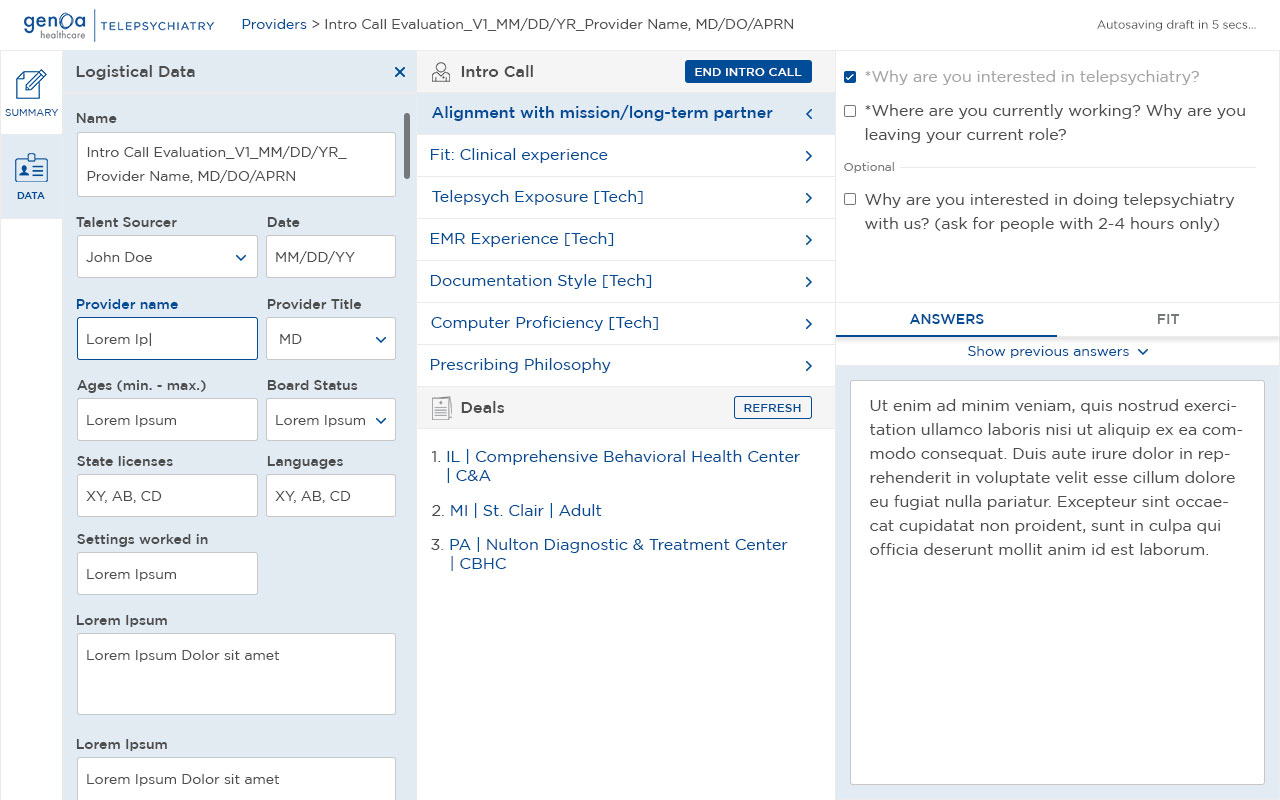
1. Unified workspace

Replaced spreadsheets, docs, and CRM with a single interface for:
  • data entry
  • prompts
  • evaluation
  • notes

2. Real-time workflow

Shifted from:
record → evaluate → re-enter
To:
capture + evaluate in one flow

3. Structured guidance

  • grouped questions into categories
  • added prompts
  • created step-by-step flow
Reduced cognitive load and improved onboarding for new hires

4. Flexible interface

  • introduced collapsible sections
  • allowed multi-panel layouts
  • enabled users to customise their workspace

5. Eliminated duplicate work

  • direct CRM integration
  • auto-saving during key steps
Removed the need for post-call re-entry

Key Design Decisions

  • Default "Summary" view → aligns with real usage
  • “Previous answers” → supports continuity across calls
  • “Partial save” → reduces pressure during incomplete sessions
  • Rubric-based scoring → standardises evaluation

Outcome

  • 55 mins → 35–40 mins total process time
  • 15–20 mins → ~5 mins post-call data entry
  • Reduced duplication and cognitive load
Business impact:
  • Reduced overall time to evaluate and place physicians
  • Increased provider throughput
  • Reduced hiring need (FTE savings)

Reflection

Even in mandatory workflows, inefficiencies show up as friction and inconsistent usage, not drop-offs.
If revisiting this, I would:

1. Identify friction points

Observe where users:
  • hesitate
  • jump between sections
  • avoid real-time input

2. Improve Post Call decision-making

Observe where users:
  • Surfacing key signals (e.g. experience, availability, red flags) in a quick summary
  • Allowing scoring during the call, not just after
  • Tightening rubric clarity with better benchmarks
  • Linking scores to inputs to reduce re-reading
This would shift the Post Call from a recall-based process to a more structured, assisted decision-making flow.

Let's work together

Feel free to drop me a message.

Thank you! Your submission has been received!
Oops! Something went wrong while submitting the form.